Trust in every answer
ChallengeA scholar’s words can’t be paraphrased into something he never said.
How we solved itAnswers carry the exact book, page and excerpt, so readers can check them.






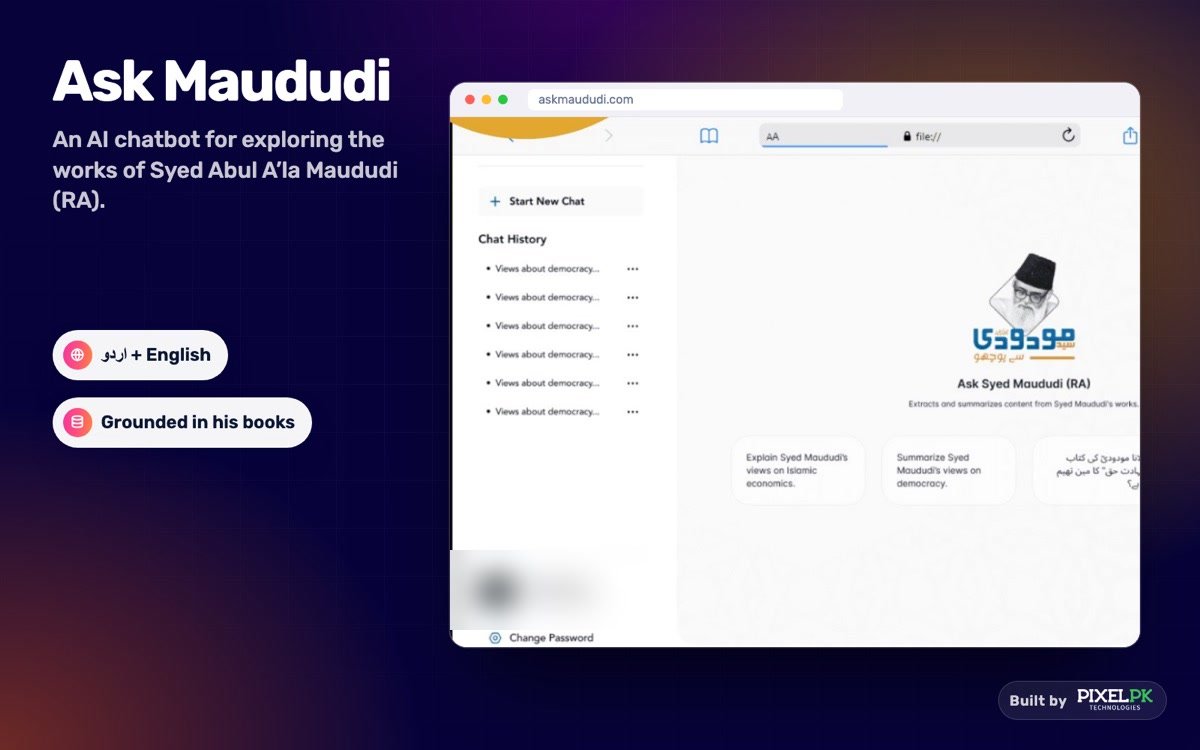
An AI assistant that answers questions from the writings of Prof. Khurshid Ahmad — every answer linked to the book, page and passage it came from. Built for the Institute of Policy Studies, Islamabad.
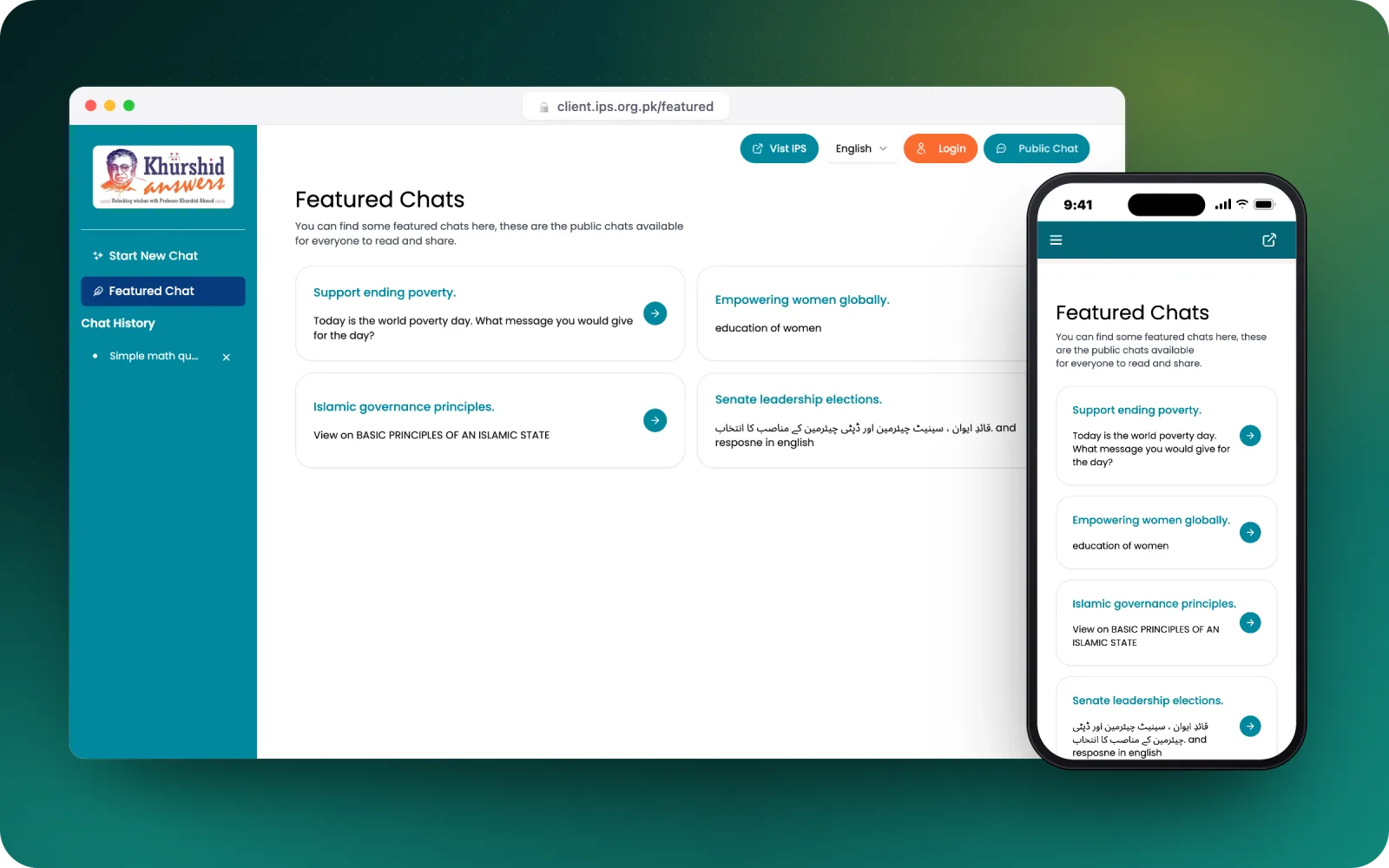
See it livekhurshidanswers.org Chat app
Professor Khurshid Ahmad’s writing on economics, governance and Islamic thought runs to more than 100,000 pages. IPS wanted students, researchers and journalists to be able to question it directly, in their own language — and to check every answer against the source.
Readers ask and listen; IPS’s editors and reviewers decide what the assistant knows.
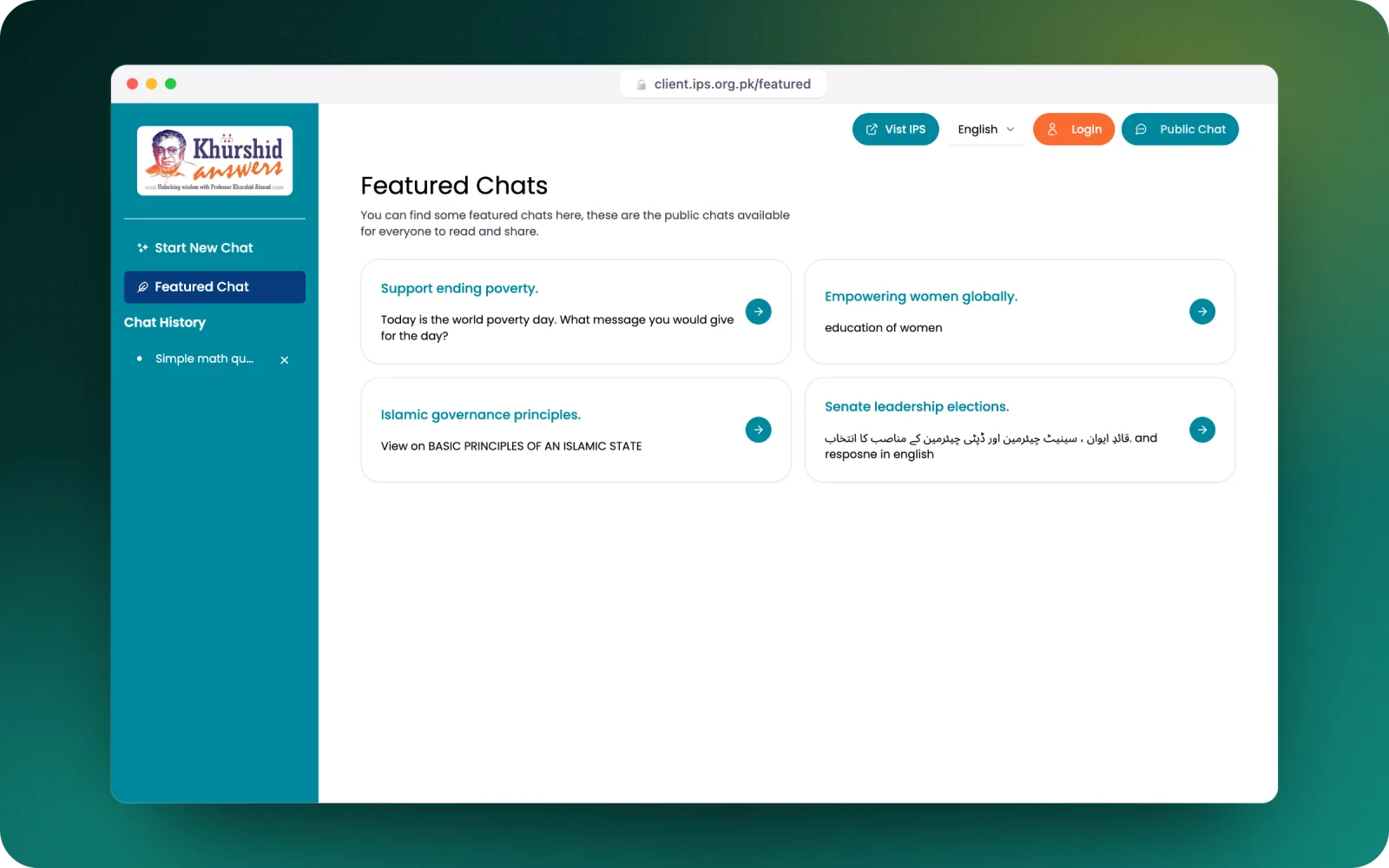
Editors and reviewers grow the library without a developer — every book is reviewed before the assistant learns from it.
6 core featuresThe library workflow and the reader’s question meet in one system.
An editor uploads it with its metadata.
A reviewer approves it for the library.
The AI server indexes it; the job is tracked to done.
A reader asks in English, Urdu, Arabic or Roman Urdu.
The answer streams in with its book, page and excerpt.
The reader app streams answers from a Python AI server and saves every conversation to the Node.js API, which also runs the library workflow and speech.
 Reader appReact · Vite · English & UrduAdmin consoleReact · TanStack Table
 APINode.js · Express · TypeScript — users, conversations, library workflow and speech
 DatabaseMongoDB
 AI serverPython — retrieval and answers
ChallengeA scholar’s words can’t be paraphrased into something he never said.
How we solved itAnswers carry the exact book, page and excerpt, so readers can check them.
ChallengeNew books and articles keep arriving.
How we solved itA draft → review → train → track workflow lets editors add content without a developer.
ChallengeMany readers prefer to listen — in English or Urdu.
How we solved itText-to-speech with word timestamps highlights each sentence as it’s read.
ChallengeQuestions arrive in English, Urdu, Arabic and Roman Urdu.
How we solved itA bilingual English/Urdu interface with right-to-left layout, and translation of any answer.
Proven, well-supported tools — chosen so the platform is easy to run and to extend.
ReactReader app & admin TypeScriptWeb, admin & API
 ViteBuild
 Tailwind CSSStylingNode.jsAPI
 ExpressAPI frameworkMongoDBDatabasePythonAI server
 OpenAISpeech & timestamps
 Google GeminiApp speech
Libraries and institutes are turning their collections into assistants people can question. The hard part is keeping every answer traceable.
Every reply carries its citation.
Reviewers decide what the AI learns.
English, Urdu, Arabic and Roman Urdu.
Natural read-aloud with highlighting.
The chat drops into the institute’s own website.
Also in production: we build AI assistants over books, legal texts and company knowledge — see Pakistan LawBot.
Tell us who will use it and what it must do. We’ll map the first release, the stack and the right team — in a free 30-minute strategy call.