





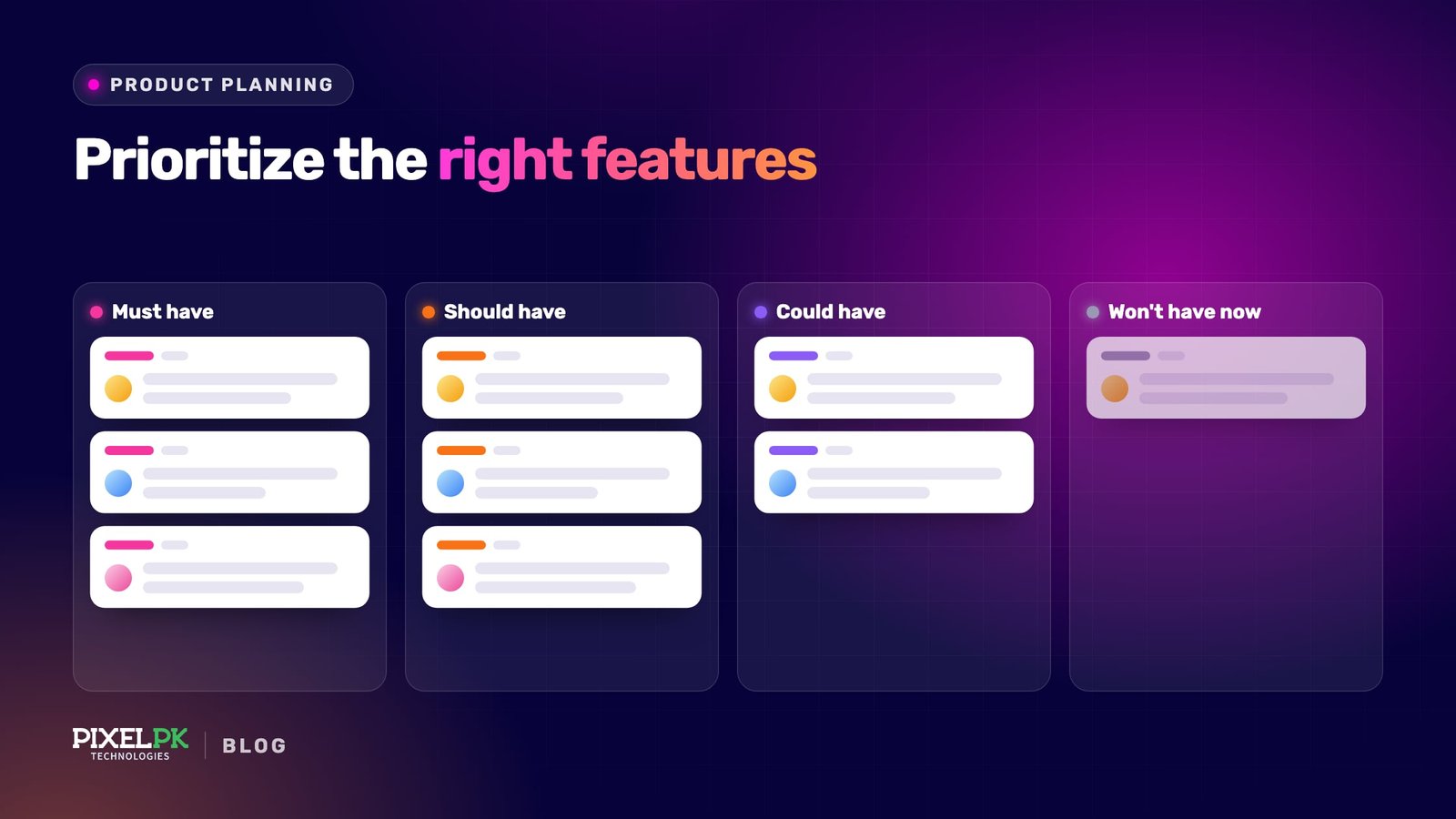
Feature prioritisation is how you decide which features of a custom software product get built first, which wait and which are never built, by weighing each one’s value against its cost, risk and urgency. It matters because the order you choose sets the budget and launch date: every feature has to be designed, built, tested and maintained, and many end up barely used.
Why prioritisation decides your cost and timeline
In custom software you pay for effort, whether the contract is fixed-price or time-and-materials. Each feature adds design, build and testing time up front, then ongoing cost: bug fixes, security updates, support and the extra complexity every later change has to work around.
Much of that spend goes on features people don’t use. Pendo’s 2019 Feature Adoption Report, based on anonymised usage data from 615 of its customer subscriptions, found that 80% of features in the average software product are rarely or never used. Bespoke tools differ from off-the-shelf SaaS, but the lesson carries over: a shorter, sharper feature list usually wins.
Scope creep is the other leak. It arrives as a dozen reasonable requests, each described as small. On a fixed-price project they become change requests; on time-and-materials, a launch date that keeps sliding.
A ranked backlog with an explicit “won’t have this time” list is the main defence. When capacity is fixed and visible, every new request becomes a trade rather than a silent addition.
Priorities also set the critical path. Integrations, compliance and data migration carry the most uncertainty, so a must-have that depends on one should start early.
MoSCoW, RICE, Kano, WSJF or value vs effort: which fits?
No framework makes the decision for you. Each structures the argument differently.
| Framework | How it works | Fits best when | Watch out for |
|---|---|---|---|
| MoSCoW | Sorts items into Must, Should, Could and Won’t have (this time) for a fixed timebox | Fixed budget or deadline; agreeing scope with non-technical stakeholders | Everything drifting into Must; no ranking within a category |
| RICE | Scores reach × impact × confidence ÷ effort | Ranking a long backlog for a live product with usage data | False precision when reach and impact are guesses |
| Kano | Classifies features by how their presence or absence affects satisfaction | Separating what users expect from what would set you apart | Needs survey responses from real users; ignores cost |
| WSJF | Divides cost of delay by job size | Work with deadlines, dependencies or market windows | Cost of delay is hard to estimate honestly |
| Value vs effort matrix | Plots items on a two-by-two grid of value against effort | Quick workshops, early scoping, small teams | Coarse; “value” means different things to different people |
MoSCoW
MoSCoW comes from the DSDM agile framework, and its rules matter more than its labels. The Agile Business Consortium’s guidance is that Must Haves should take no more than 60% of the effort in a timebox, with Could Haves at around 20% forming the main contingency. A Must list that fills the budget leaves no room for wrong estimates.
RICE
RICE was developed by Intercom’s product team. Reach is people or events affected per period (Intercom uses a quarter), impact runs from 0.25 (minimal) to 3 (massive), confidence is 100%, 80% or 50%, and effort is in person-months. It works best with real usage numbers; before launch, reach is a guess.
Kano
The Kano model comes from Noriaki Kano and colleagues’ paper “Attractive Quality and Must-Be Quality”. It sorts features into must-be (expected; missing them causes dissatisfaction), one-dimensional (more is better) and attractive (unexpected delighters). It surfaces must-be features that never reach a wish list because users assume them.
WSJF
Weighted Shortest Job First, from the Scaled Agile Framework, is estimated as the relative cost of delay divided by the relative job duration. Cost of delay combines business value, time criticality, and risk reduction or opportunity enablement. It suits work where a regulatory deadline, contract renewal or seasonal peak gives waiting a real price.
Value vs effort
The simplest option: plot each item on two criteria and start in the high-value, low-effort corner. Nielsen Norman Group’s guide to prioritisation matrices recommends silent dot voting, with each person given roughly half as many votes as there are items, so the loudest voice doesn’t set the order.
Many teams combine two. For a first release with no usage data, MoSCoW plus a value-versus-effort workshop is usually enough. Add RICE once there are real numbers to feed it.
How to scope an MVP, step by step
A minimum viable product is the smallest release that lets real users complete the core job and tells you what to build next. It is a smaller product, not a lower-quality one.
- Name the outcome. Write one sentence on what the first release must prove, and the metric that will show it.
- Map the core journey. Lay out a user’s steps from start to finish as a story map. The thinnest working path through every step is your skeleton.
- Collect every request in one list. Include stakeholder asks, interview notes and support tickets. Attach each to a journey step; anything that doesn’t fit goes to a parking list.
- Size it with the people who will build it. Rough sizes are enough. Flag unknowns such as integrations, payments and compliance, and spike the riskiest.
- Score and rank. Apply your framework, then check the order against the journey: a high scorer off the core path can usually wait.
- Draw the release line. Fit the Must Haves inside no more than 60% of available effort and keep the rest as contingency.
- Write the won’t-have list. Record what is out of this release and why, and get the sponsor to sign it off.
- Decide how you will judge it. Instrument the launch metrics before release and set a date to review the backlog with real data.
Take a product shaped like Secure Lien Release, a subscription SaaS for US contractors covering estimates, invoices, card payments and lien waivers. The chain from estimate to waiver is the skeleton, and every link must work before any one is polished: a perfect estimate is no help to a contractor who can’t collect payment.
Security, data protection, accessibility and performance belong on the Must list too. Nobody requests them, which is why they get squeezed.
Getting stakeholders to agree on what ships first
Most prioritisation fights are really disagreements about goals. Agree the outcome and scoring criteria first, and arguments about individual features get much shorter.
Then make the constraint visible: capacity as a fixed box, the ranked list against it. When someone wants a new report added, the question becomes which item it replaces.
Vote privately on the first pass so seniority doesn’t settle the order. Name one decision owner, usually the product owner or sponsor, to break ties. A group that needs unanimity tends to say yes to everything, which is how scope creeps.
Shared platforms need extra care. When one product serves several organisations, as the Study Abroad CRM does for six study-abroad consultancies, ask whether a request serves the shared journey (there, enquiry to visa in one student file) or one organisation’s habit. The second is often better solved with configuration.
Using analytics, interviews and AI to inform priorities
Customer interviews
Before launch, interviews and existing workflows are your best evidence. Ask people about the last time they did the task and what went wrong, rather than which features they want. Past behaviour is a more reliable guide than predictions about future use.
Study the workaround the software will replace: the spreadsheet, the WhatsApp group, the paper form. What people already do weekly is a strong Must Have candidate.
Product analytics
Once anything is live, instrument the core journey. Funnels, retention and feature adoption reports in PostHog, Amplitude or Mixpanel show where people drop out and what they return to. Feature flags let you release to a subset of users and measure first.
Analytics tells you what people do, not why. Pair a drop-off with a few conversations before you prioritise a fix.
AI tools
AI now handles much of the sorting. Research tools such as Dovetail transcribe and summarise recorded interviews, group findings into themes and answer questions with citations. Large language models can cluster hundreds of support tickets into themes and draft first-pass RICE scores.
Analytics platforms also expose their data through the Model Context Protocol (MCP). PostHog’s MCP server, for example, connects to Claude Code, Cursor, Codex and VS Code, so an agent can run queries and manage feature flags and experiments from plain-language prompts.
Treat AI output as a draft. Check theme counts against raw data, watch for summaries that over-weight a few vocal customers, and check where personal data in interviews and tickets is processed.
Coding agents change the effort side too. Some features are quicker to build, but review, testing and maintenance don’t shrink as much. Cheap to generate is not cheap to own.
Re-prioritising after launch
Launch turns guesses into data, so the backlog should change. Light re-ranking each sprint and a deeper quarterly review suit most products; SAFe’s position is that backlogs are continuously prioritised, not set once. Weigh:
- Adoption and retention by feature
- Support volume and the themes behind it
- Deals won or lost on a missing capability, and churn reasons
- Bugs, performance and security issues
- Technical debt that slows every future change
Reserve a fixed share of each sprint for bugs and technical debt. Without it, feature work wins every ranking.
Be willing to remove things. A little-used feature still costs maintenance, so retiring it is a legitimate priority. Kano categories drift too: what delighted users at launch becomes expected later.
Products with several user groups need one view of the trade-offs. A renovation platform like Flipro, with Flutter apps and a Laravel CRM, has app users and CRM users competing for the same team; separate backlogs hide that competition.
Common prioritisation pitfalls
- Must-have inflation. When most of the effort is marked Must, the label has stopped meaning anything.
- Loudest voice wins. The most senior person or biggest customer sets the order without evidence.
- Scoring theatre. Decimal-point scores built on guesses look rigorous but aren’t. Argue about the inputs instead.
- Counting build cost only. Maintenance, support and added complexity are real costs.
- No won’t-have list. Deferred items quietly return as small additions.
- Churning priorities mid-sprint. Batch changes for the next planning session unless something is genuinely urgent.
Sometimes a formal framework is overkill. A small internal tool with one sponsor, or work whose scope a regulator has already set, needs only a ranked list. Frameworks earn their keep when the backlog is long and stakeholders are many.
How Pixelpk approaches this
Pixelpk Technologies is an AI and software development company founded in 2018 and headquartered in Lahore, Pakistan, with offices in Malaysia, the UK, Australia, Saudi Arabia and the US. Its team of 50+ has shipped more than 1,000 projects and is rated 4.9/5 on Clutch.
Pixelpk builds custom software under three engagement models: Extended Team, Managed Dedicated Team and Custom Solution Development. Examples include Secure Lien Release, Flipro and the Study Abroad CRM above, with more on the case studies page. It also builds and runs its own AI products in production, including Pakistan LawBot, Aivastark and Brandiz.
For the wider decisions around a build, including choosing a partner, see 5 key factors for successful custom software development. For a second opinion on an MVP scope, book a free strategy call.
Frequently asked questions
Which feature prioritisation framework is best for a custom software project?
There is no single best framework. MoSCoW suits a first release with a fixed budget because it forces an explicit won’t-have list. RICE suits a live product with usage data, Kano finds features users simply expect, and WSJF fits deadline-driven work. Many teams combine two, such as Kano to understand users and MoSCoW to commit scope.
How many features should an MVP include?
There is no right number. An MVP should include only what a user needs to complete the core job from start to finish, plus the security and reliability that make it safe to use. If removing a feature would not stop someone completing that journey, it can usually wait for a later release informed by real usage.
How do you stop scope creep in a custom software project?
Fix the capacity and make it visible, keep a ranked backlog, and write down what will not be built this time, with the sponsor’s sign-off. Every new request then has to replace something of similar size rather than being added quietly. Name one decision owner who can say no, and batch changes for the next planning session.
Who should make the final call on feature priorities?
One accountable person, usually the product owner or project sponsor, should hold the final decision. Stakeholders, users and the development team provide input, scores and estimates, but a group that needs unanimous agreement tends to approve everything. The decision owner applies the agreed goals and criteria consistently and explains the trade-offs.
How often should feature priorities be reviewed after launch?
Most products benefit from light re-ranking every sprint and a deeper review every quarter, weighing analytics, support themes, revenue signals and technical debt together. Avoid changing priorities mid-sprint unless something is genuinely urgent, such as a security issue, because constant switching slows delivery and makes estimates unreliable.
Can AI tools prioritise features for you?
AI tools can do much of the groundwork: transcribing and clustering customer interviews, grouping support tickets into themes, querying product analytics in plain language and drafting first-pass scores. They should not make the final decision. Check their summaries against raw data, watch for bias towards a few vocal customers, and keep an accountable person responsible.