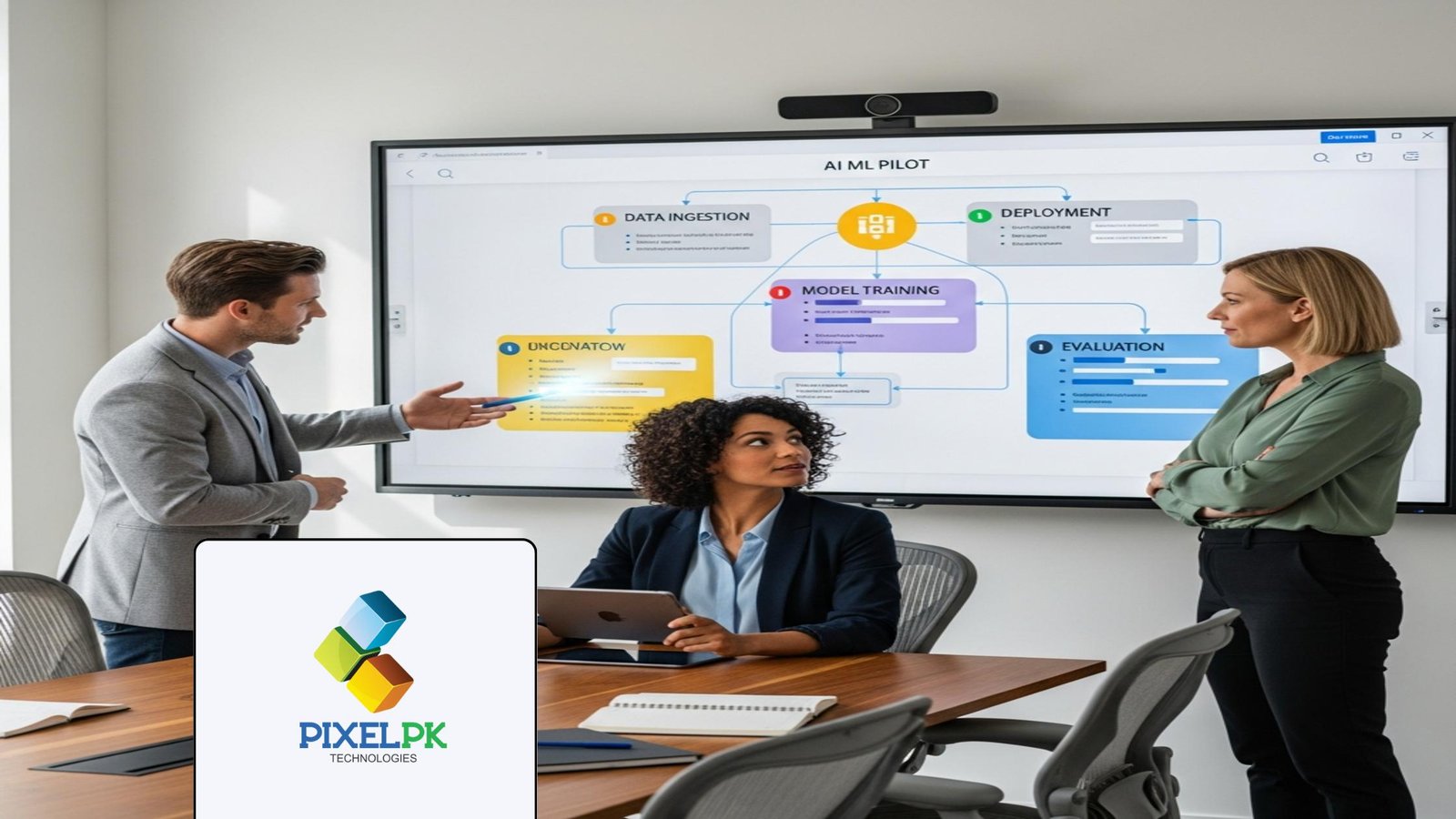




Mastering Deploying AI/ML Solutions for Business Growth
Understanding Deploying AI/ML Solutions is essential for modern businesses looking to scale operations and enhance efficiency. Successfully Deploying AI/ML Solutions enables companies to leverage cutting-edge technology. This transforms data into actionable insights and automates complex processes.
Many organizations develop promising AI models. However, they struggle with moving these models from development to a live production environment. This crucial step is often the biggest hurdle. Pixelpk Technologies helps businesses overcome this challenge.
The Imperative of Deploying AI/ML Solutions Today
The competitive landscape demands agility and innovation. Businesses must integrate advanced analytics and machine learning. This drives decision-making and creates new value streams. Therefore, effective deployment is not just a technical task. It is a strategic business imperative.
Why Production Readiness Matters
A functional AI model in a lab environment holds limited value. Its true impact emerges only when it operates seamlessly in production. Production readiness ensures robustness, scalability, and security. This means the solution performs reliably under real-world conditions.
Furthermore, production-ready systems can handle increasing data volumes and user loads. They integrate smoothly with existing enterprise systems. This operational stability is vital for continuous business operations.
Bridging the Gap: From POC to Production
Many AI projects stall at the Proof-of-Concept (POC) stage. This gap often results from a lack of clear deployment strategies. It also stems from insufficient MLOps expertise. MLOps, or Machine Learning Operations, streamlines the lifecycle of ML models. This includes everything from data collection to deployment and monitoring.
Closing this gap requires a structured approach. It involves robust engineering practices and cross-functional collaboration. Moreover, it ensures that models are not just accurate, but also deployable, maintainable, and scalable.
Key Stages in Deploying AI/ML Solutions: A Practical Playbook
Deploying AI/ML Solutions involves several critical stages. Each step requires careful planning and execution. Following a structured playbook minimizes risks and maximizes success.
Data Preparation and Feature Engineering
High-quality data forms the foundation of any AI/ML model. This initial stage focuses on collecting, cleaning, and transforming raw data. Furthermore, feature engineering extracts relevant attributes. These features significantly improve model performance and accuracy.
Model Development and Training
This stage involves selecting appropriate algorithms and training models. Engineers use prepared data to build and refine the AI solution. Iterative training processes optimize model parameters. This ensures the model learns effectively from the data.
Model Validation and Testing
Before deployment, rigorous validation is essential. Models undergo extensive testing using unseen data. This assesses their performance, generalization, and bias. Metrics like accuracy, precision, and recall help evaluate effectiveness. Additionally, A/B testing can compare model versions.
Infrastructure Setup and MLOps
MLOps is crucial for efficient and reliable deployment. It automates and standardizes the entire ML lifecycle. This includes continuous integration, continuous delivery, and continuous training. Robust infrastructure supports the model’s operational demands. For a deeper dive into MLOps best practices, explore resources like Google Cloud’s MLOps guide.
Containerization and Orchestration
Containerization packages the model and its dependencies. Docker containers, for example, ensure consistent environments. Orchestration tools like Kubernetes manage these containers. They provide scalability, high availability, and efficient resource utilization.
CI/CD Pipelines for ML
Continuous Integration (CI) and Continuous Delivery (CD) pipelines automate code changes. For ML, this extends to data, models, and infrastructure. These pipelines ensure rapid, reliable updates. They reduce manual errors and accelerate deployment cycles.
Deployment Strategy and Execution
The actual process of Deploying AI/ML Solutions requires a clear strategy. This includes choosing the right deployment environment. Options include cloud, on-premise, or hybrid setups. Gradual rollouts, like canary deployments, minimize risk. They allow monitoring performance in real-time.
Monitoring, Maintenance, and Retraining
Post-deployment, continuous monitoring is vital. This tracks model performance, data drift, and anomalies. Regular maintenance addresses any issues promptly. Furthermore, models require periodic retraining with fresh data. This helps them adapt to changing patterns and maintain accuracy over time.
Realizing Measurable ROI from Deploying AI/ML Solutions
Successful AI/ML deployment directly impacts business outcomes. It generates significant return on investment (ROI). This value comes from increased efficiency, improved decision-making, and new revenue streams.
Performance Metrics and KPIs
Measuring ROI starts with defining clear Key Performance Indicators (KPIs). These might include cost reduction, revenue growth, or enhanced customer satisfaction. Tracking these metrics provides concrete evidence of success. It also guides future optimizations and improvements.
Business Impact and Value Creation
Deploying AI/ML Solutions can revolutionize various business functions. For example, predictive analytics can optimize supply chains. Automated customer service bots enhance user experience. Fraud detection systems reduce financial losses. The ultimate goal is creating tangible business value.
Common Challenges and How to Overcome Them
Despite the benefits, challenges often arise during deployment. Addressing these proactively is key. Effective strategies help ensure smooth operations.
Data Drift and Model Decay
Data drift occurs when incoming data changes over time. This can degrade model performance. Regular monitoring helps detect drift early. Implementing automated retraining pipelines combats model decay. This ensures models remain relevant and accurate.
Scalability and Performance Issues
Poorly designed infrastructure can lead to scalability bottlenecks. This impacts response times and overall user experience. Using cloud-native services offers elastic scalability. Employing efficient model architectures also improves performance. Load testing helps identify potential issues before they impact users.
Security and Compliance Concerns
AI/ML systems often handle sensitive data. Therefore, robust security measures are paramount. This includes encryption, access control, and regular security audits. Compliance with regulations like GDPR or HIPAA is also critical. Establishing clear data governance policies minimizes risks.
Partnering with Pixelpk for Seamless Deploying AI/ML Solutions
Pixelpk Technologies specializes in bringing AI/ML initiatives to life. Our expert team provides end-to-end services. We cover everything from strategy and development to seamless deployment and ongoing support. We ensure your models deliver real business value.
Our approach combines deep technical expertise with a focus on your business goals. We leverage best practices in MLOps and cloud engineering. This guarantees scalable, secure, and high-performing AI/ML systems. Partner with us for reliable Deploying AI/ML Solutions.
Frequently Asked Questions
What is MLOps and why is it crucial for AI/ML deployment?
MLOps (Machine Learning Operations) is a set of practices. It automates and standardizes the entire machine learning lifecycle. This includes model development, deployment, and ongoing management. MLOps is crucial for ensuring models are scalable, reliable, and maintainable in production environments. It bridges the gap between data science and operations.
How do you ensure data security during deployment?
Pixelpk Technologies implements robust security measures. These include end-to-end encryption for data in transit and at rest. We also use strict access controls and identity management. Regular security audits and compliance checks are part of our process. Our solutions adhere to industry-best security standards.
What kind of support does Pixelpk offer post-deployment?
We provide comprehensive post-deployment support. This includes continuous monitoring of model performance and infrastructure. We offer proactive maintenance and rapid incident response. Our team also manages model retraining and updates. This ensures your AI/ML solutions remain optimal and effective.
What is the typical timeline for deploying an AI/ML solution?
The timeline varies significantly based on complexity and scope. A simple model might take a few weeks to deploy. More complex, integrated solutions could require several months. We work closely with clients to establish realistic timelines. Our agile methodologies help streamline the process and accelerate delivery.
Conclusion
Successfully Deploying AI/ML Solutions is a complex yet highly rewarding endeavor. It transforms innovative ideas into tangible business value. A structured approach, combined with MLOps best practices, is crucial. This ensures reliability, scalability, and measurable ROI.
Businesses must move beyond theoretical models to impactful production systems. This requires expertise in data engineering, model development, and robust infrastructure. Partnering with a specialist like Pixelpk Technologies simplifies this journey. We empower your business to harness the full potential of AI.
Ready to bring your AI/ML projects to life? Pixelpk Technologies delivers agile, scalable solutions. We help you achieve measurable results. Explore our mobile app development services or learn more about our AI capabilities today.